Analysis · AI
Gemini 4 Neon Arrives. How Does It Compare With Carbon and Hydrogen?
Google has launched Gemini 4 Neon for coding and complex workflows. Compare it with Carbon, Hydrogen and Argon, with official charts and selected Claude and GPT benchmarks.
Event date: 2026-11-18

Ever asked an AI to do something complicated, then spent the next few minutes wondering when it would finish? Google is targeting that gap with Gemini 4 Neon, announced on November 18, 2026. The pitch is deep reasoning with faster, more efficient task completion.
Where does Neon fit in the Gemini 4 family?
Neon is adapted from Gemini 4 Carbon. Hydrogen focuses on fast everyday execution, while Carbon targets the toughest long-running projects. Neon sits between them. Argon, meanwhile, remains listed in the API documentation as an efficient reasoning model.
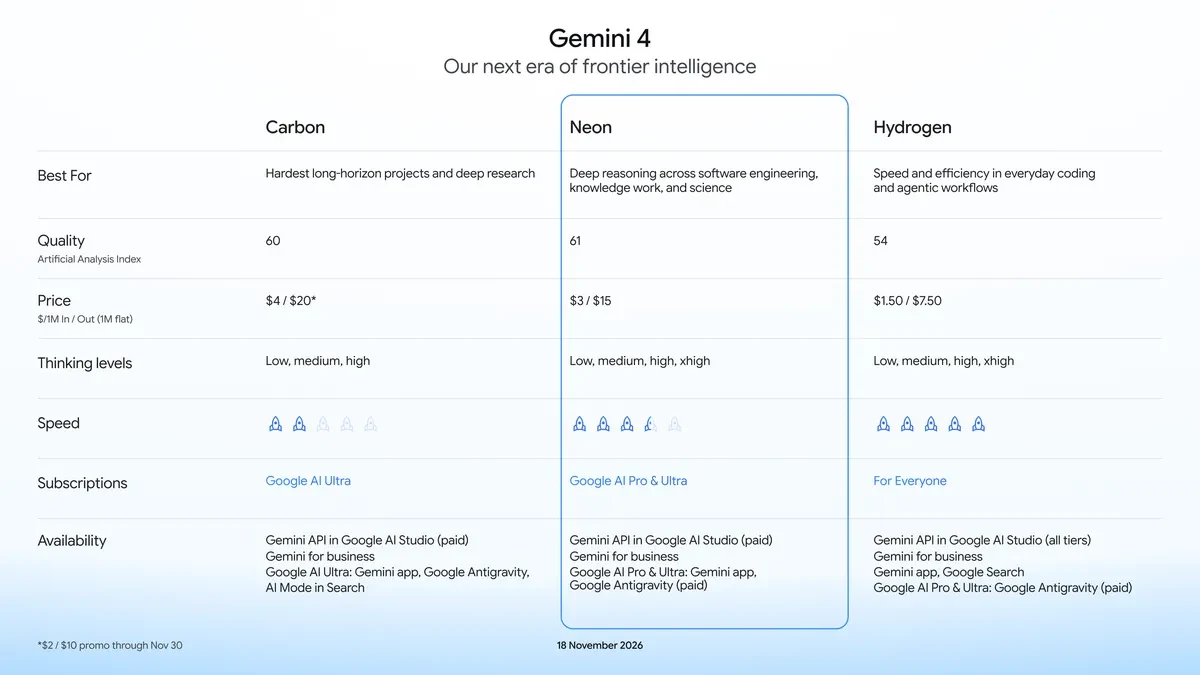
| Model | Google’s intended focus | Standard API: input / output per 1M tokens |
|---|---|---|
| Hydrogen | Fast everyday coding and agent workflows | US$1.50 / US$7.50 |
| Argon | Efficient reasoning, faster responses than Carbon | US$2 / US$10 during promotion |
| Carbon | The hardest long-running projects and deep research | US$2 / US$10 during promotion |
| Neon | Complex coding, knowledge work and science | US$3 / US$15 |
Prices checked November 19. Argon and Carbon promotions end November 30, 2026; both move to US$4/US$20 on December 1. These are API rates, not Gemini subscription prices. Thinking tokens are billable, while caching, batch processing and tools have their own pricing terms.
There is more here than chat
Neon accepts text, images, audio and video within a combined context window of up to one million tokens. Think lengthy documents, spreadsheets and code changes in a connected workflow. Video input means understanding video here; it should not be confused with native generative video production.
Google also demonstrated a 3D scene built through Blender MCP and a WebGL simulation prototype. That could appeal to developers experimenting with ideas, but these demos use supporting tools. They do not establish that every prompt can produce a finished game.
How does it compare with Claude and GPT?
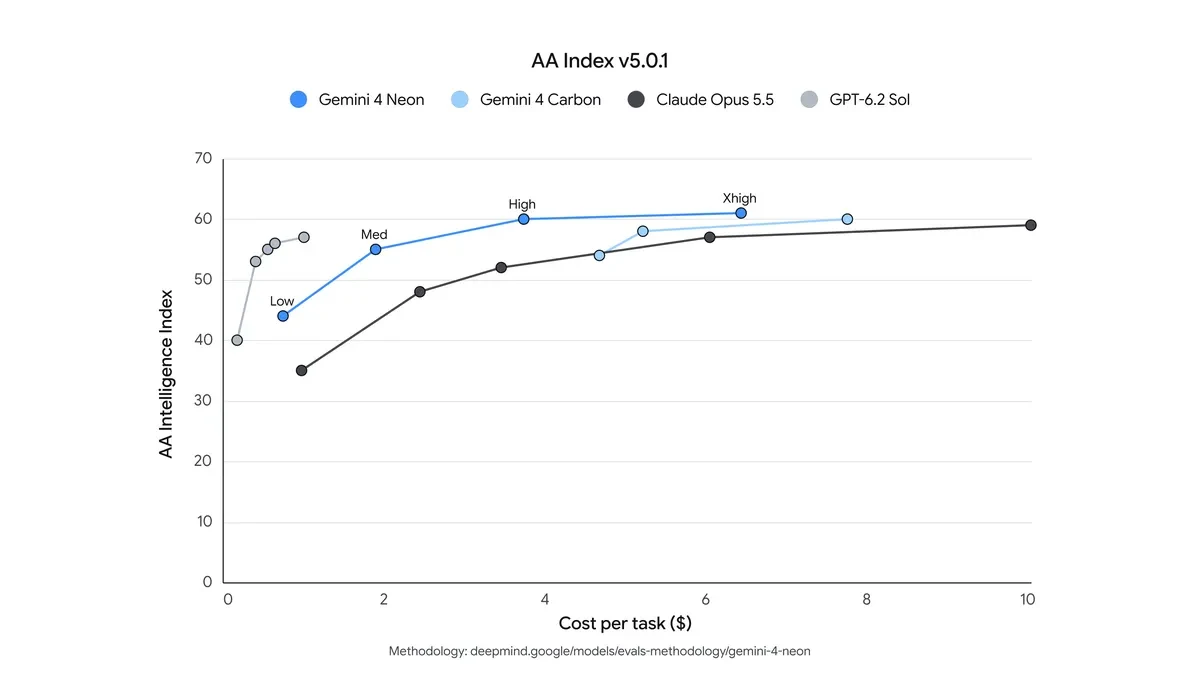
The chart below plots Artificial Analysis Intelligence Index v5.0.1 scores against cost per task. Neon offers low, medium, high and xhigh thinking levels, with high as the default. More thinking can increase both scores and cost, so the model name alone is not enough for a fair comparison.
| Benchmark | Gemini 4 Neon | Claude Opus 5.5 | GPT-6.2 Sol |
|---|---|---|---|
| AA Index v5.0.1 | 61 | 59 | 57 |
| Terminal-bench 4.1, cheating adjusted | 65.2% | 65.8% | 61.5% |
| FrontierCode 2.0 | 46.2% | 47.3% | 43.8% |
| Chartography | 73.5% | 66.3% | 75.1% |
These are selected results from Google’s model card, not Selzenn tests. Neon leads this combined index, but Opus scores higher on the two coding tests shown, while Sol leads Chartography. The useful choice still depends on the work you actually need done.
Google’s methodology uses the highest reasoning level unless noted otherwise; Neon uses high for FrontierCode. Some competitor results are provider-reported, and agent harnesses or environments can differ. Scores from different benchmarks cannot be added into one overall capability percentage.
Lower cost needs a little context
Google says Neon at high costs 32% less per task than Carbon in the evaluation it cites. That differs from per-token pricing: Carbon is currently cheaper per token during its promotion. Thinking tokens, repeated attempts and tool use affect the final bill. The chart illustrates that trade-off; it does not promise 32% savings on every task.
Where can you try it?
Neon is available through the paid Gemini API in Google AI Studio. Google AI Pro and Ultra subscribers also get access through the Gemini app and Google Antigravity, depending on the channel. API billing remains separate, and Neon has no free API tier. A practical comparison starts with the same task across models, recording result quality, completion time and cost—not just the highest benchmark score.
Sources & references
- Google: Introducing Gemini 4 Neon (18 November 2026) ↗blog.google
- Google DeepMind: Gemini 4 Neon model card ↗deepmind.google
- Gemini API pricing: current and promotional rates ↗aistudio.google.com
- Google DeepMind: Gemini 4 Neon evaluation methodology ↗storage.googleapis.com