News · AI
Microsoft Launches MAI Code 2 and Flash, With Coding Costs in Focus
MAI Code 2 and Code 2 Flash split deeper engineering work from routine edits. Microsoft highlights efficiency, but its cost comparisons include promotional pricing.
Event date: 2026-11-17
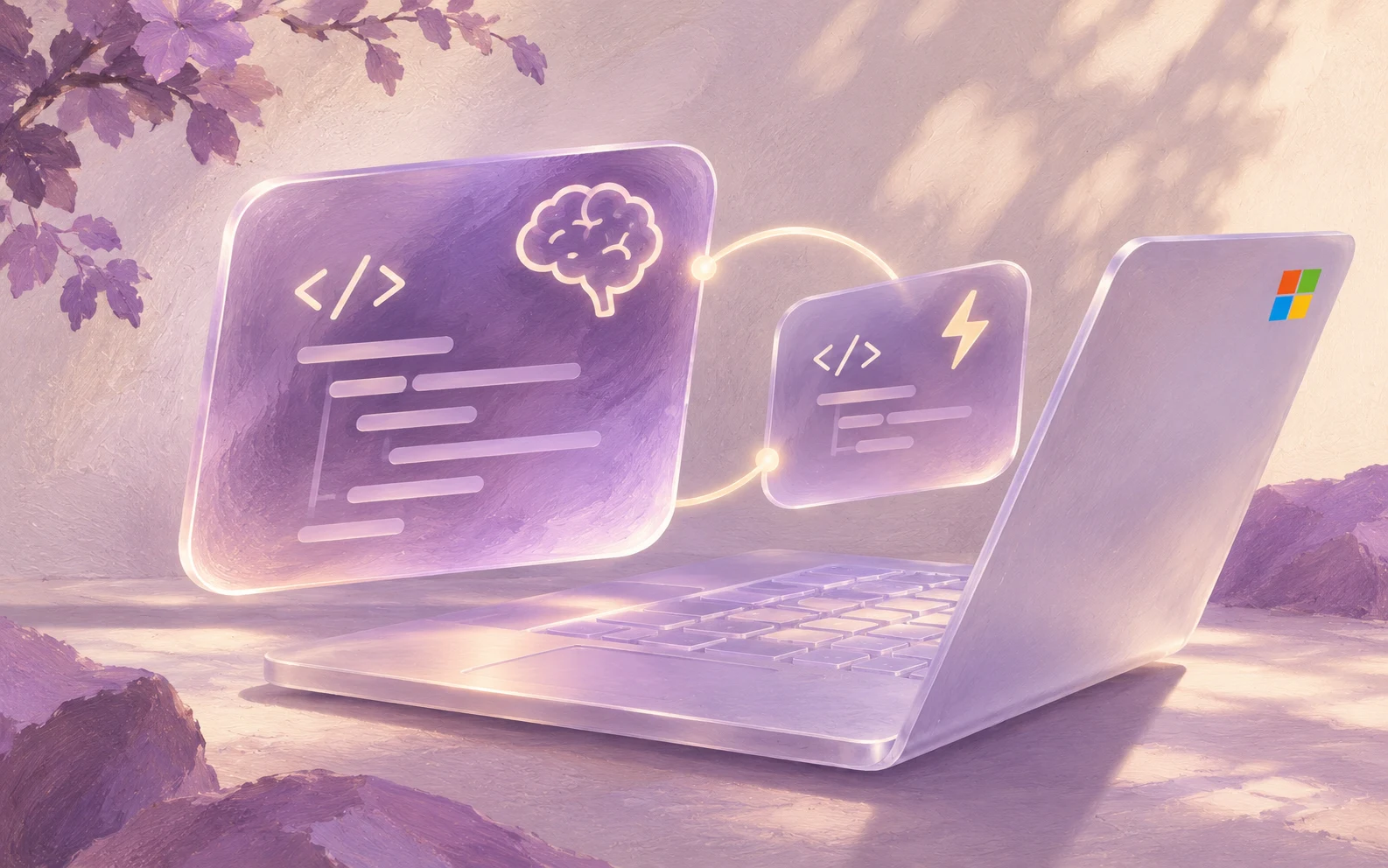
Not every coding task needs the heaviest model. Sometimes you just want to understand an old function, fix a small bug or tidy a few lines. A change spread across many files calls for something different. Microsoft is using that split to introduce MAI Code 2 and Code 2 Flash.
Announced on November 17, 2026 during Ignite, the models focus on everyday enterprise software engineering. Efficiency is central to the pitch, rather than simply chasing a single top benchmark score.
Code 2 for deeper work, Flash for routine volume

| Model | Work highlighted by Microsoft |
|---|---|
| MAI Code 2 | Deep debugging, multi-file implementation, repository-wide reasoning and UI |
| MAI Code 2 Flash | Code explanations, targeted edits, routine fixes and rapid iterations |
In practical terms, Flash targets frequent, higher-volume tasks, while Code 2 addresses changes that need broader understanding. That is a useful way to choose a tool, but the results still need to be judged against work in your own repository.
The cost claim comes with a promotion
Averaged across four coding benchmarks, Microsoft says Code 2 achieves 98% of GPT-6.1 Sol’s performance at 40% of its cost, and 96% of Claude Opus 5.5’s performance at 5% of its cost. Those are relative results in that evaluation, not the percentage of all coding tasks guaranteed to succeed.
The tests are DeepSWE 1.1, TerminalBench 2.1, SWE Atlas and FrontierCode 1.1. The methodology specifies maximum reasoning effort. Three tests use Microsoft’s internal MSBench platform with GitHub Copilot CLI and no subagents; FrontierCode results come from Artificial Analysis.
Crucially, the MAI Code 2 cost calculation uses a 50% promotional price. The 5%-of-competitor-cost claim should not be treated as a permanent standard rate. It is not a direct comparison with the newer GPT-6.2 Sol either, and these are not independent Selzenn tests.
Does it generate pictures too?
The model card says both models accept text and images, but produce text. Image input can supply context when coding involves a visual interface. That is different from an image-generation model producing illustrations or photographs.
Microsoft also says the family is not yet tuned for fundamental science research or very long-horizon agentic work. Efficiency on routine coding should not automatically be extended to every kind of AI task.
Where can you try it?
The dedicated launch announcement lists Code 2 and Flash in GitHub Copilot, with Code 2 Flash also in limited-access preview in Microsoft Foundry. OpenRouter, Vercel, Hermes, OpenCode and Kilo support is described as coming soon in that announcement; it does not establish that all those channels are already active.
Start with a small bug you understand, review the proposed change and run your project checks before accepting it. Then compare time, change quality and usage cost under your plan. For everyday development, those three measures can be more useful than simply picking the biggest model name.