News · AI
Qwen4-Max Is Here: Alibaba’s AI for Coding and Long-Running Work
Qwen4-Max brings a million-token context window, Blender demos, game development and agentic video workflows. Explore its features and comparisons with other AI models.
Event date: 2026-11-16
Ever wanted an AI assistant that could follow a job from reading the background material to preparing something useful? Alibaba is pushing in that direction with Qwen4-Max, officially introduced on November 16, 2026. Its focus includes coding, professional work and tasks that need to unfold over several stages.
What is new in Qwen4-Max?
In Alibaba’s announcement, the model brings native vision and a one-million-token context window. Context is the space available for material processed in a conversation. Tokens are pieces of text or representations of input, so a million tokens does not mean a million words.
A simple way to think about it is having room to bring more material into one job. Long context still needs structure: state the goal clearly, separate relevant material and ask for a result you can check. Capacity alone does not guarantee that every detail will be understood correctly.
3D modeling: from geometry to rendering in Blender
In QwenTeam’s demonstration, Qwen4-Max uses Blender for geometry, scene assembly, materials, lighting and rendering. Examples include architecture, interiors, landscapes and science-fiction scenes. This is a workflow through 3D software, beyond an image that simply looks three-dimensional.
For creators, the interesting possibility is turning instructions into a scene they can continue working on. Check dimensions, object placement, materials and renders before using it in a project. A vendor demo does not establish that every brief will immediately produce a production-ready asset.
Game development: working with real engines
QwenTeam names Unity, Unreal Engine and Godot. The workflow covers scenes, gameplay logic, external assets, materials, HUDs and effects, followed by testing and refinement using visual and interaction feedback. The Meow of Magic demo uses Unreal Engine for a cat-mage adventure.
A practical starting point is a small prototype: one arena, one mechanic and one win condition. Then check controls, collisions, performance and asset permissions. A successful showcase does not mean a commercial game can be completed from a single sentence.
Agentic video production: storyboards, cameras, clips and editing
QwenTeam shows Qwen4 working with WonderClip: refining storyboards, creating static assets, setting camera motion in blockouts, rendering clips and editing them into a multi-scene film. A blockout is an early spatial layout for shape, scale and camera movement. This depends on that toolchain; it is not the same as a standalone text-to-video feature in every Qwen4-Max endpoint.
Charts: Qwen4-Max versus Claude, GPT and Kimi
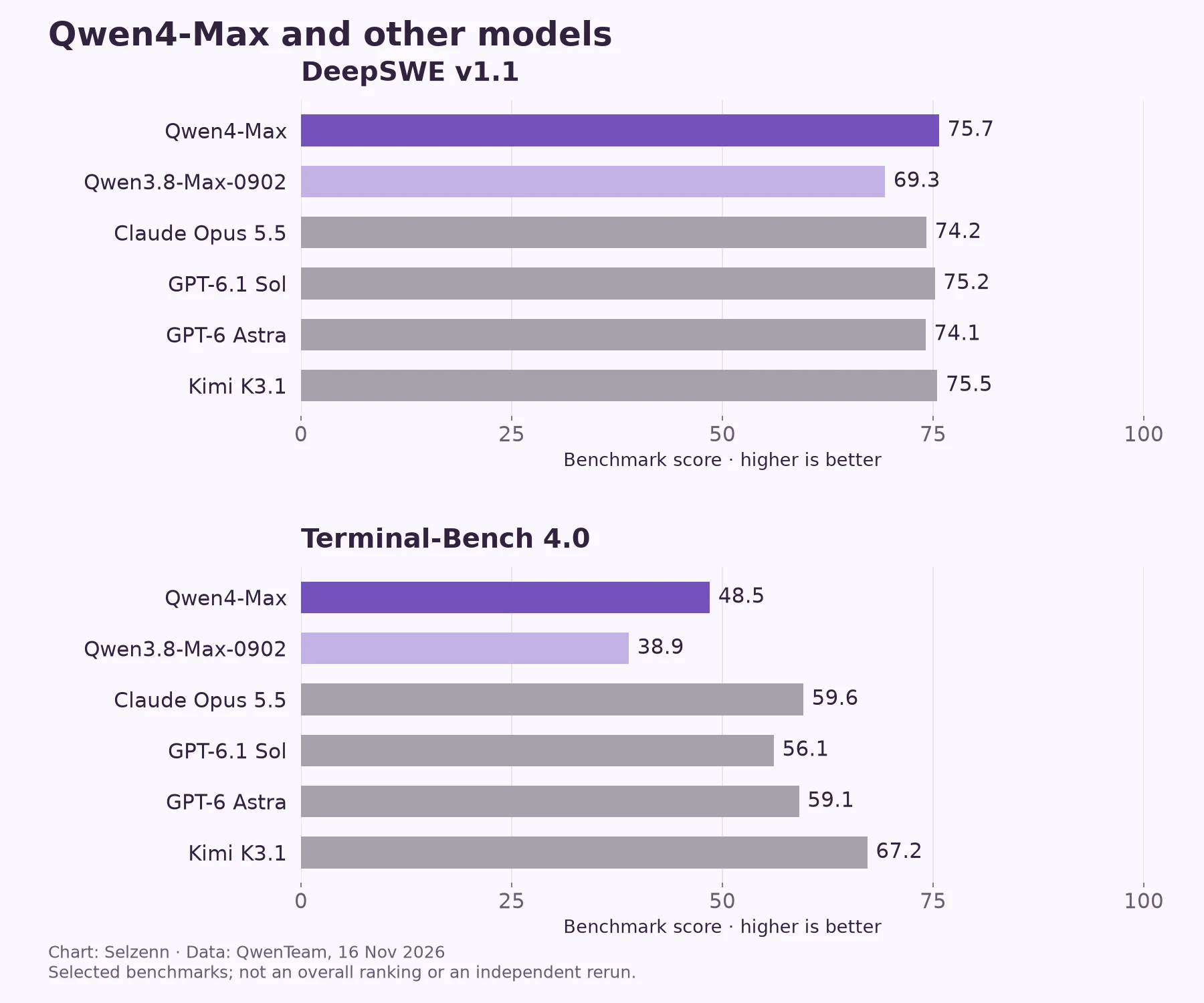
Selzenn prepared the charts below from QwenTeam’s official summary figures, without rerunning the tests. DeepSWE evaluates agentic coding, while Terminal-Bench tests terminal work. Benchmark versions are included so results from different evaluations are not confused.
The picture is mixed. Qwen4-Max scores 75.7 on DeepSWE v1.1, while its Terminal-Bench 4.0 score of 48.5 trails Kimi K3.1 at 67.2. A single chart is therefore not enough to call one model the best at every job.
| Model | DeepSWE v1.1 | Terminal-Bench 4.0 | ProgramBench |
|---|---|---|---|
| Qwen4-Max | 75.7 | 48.5 | 31.5 |
| Qwen3.8-Max-0902 | 69.3 | 38.9 | 28.0 |
| Claude Opus 5.5 | 74.2 | 59.6 | 65.0 |
| GPT-6.1 Sol | 75.2 | 56.1 | 52.5 |
| GPT-6 Astra | 74.1 | 59.1 | 55.0 |
| Kimi K3.1 | 75.5 | 67.2 | 25.0 |
The table adds ProgramBench to show an area less favorable to Qwen4-Max as well. All values come from the same vendor summary. Check model configuration, evaluation tools, reasoning budgets and measurement dates before comparing them with other leaderboards. Qwen’s footnotes also distinguish externally cited leaderboards from evaluations run by the team.
Work360: higher scores and lower evaluation task costs
On QwenTeam’s Work360 evaluation, the new generation scores 52.69 against Qwen3.8-Max’s 47.74. The same blog reports average task costs falling from US$4.43 to US$1.67. These belong to the Work360 evaluation, rather than API rates or guaranteed savings for every workload.
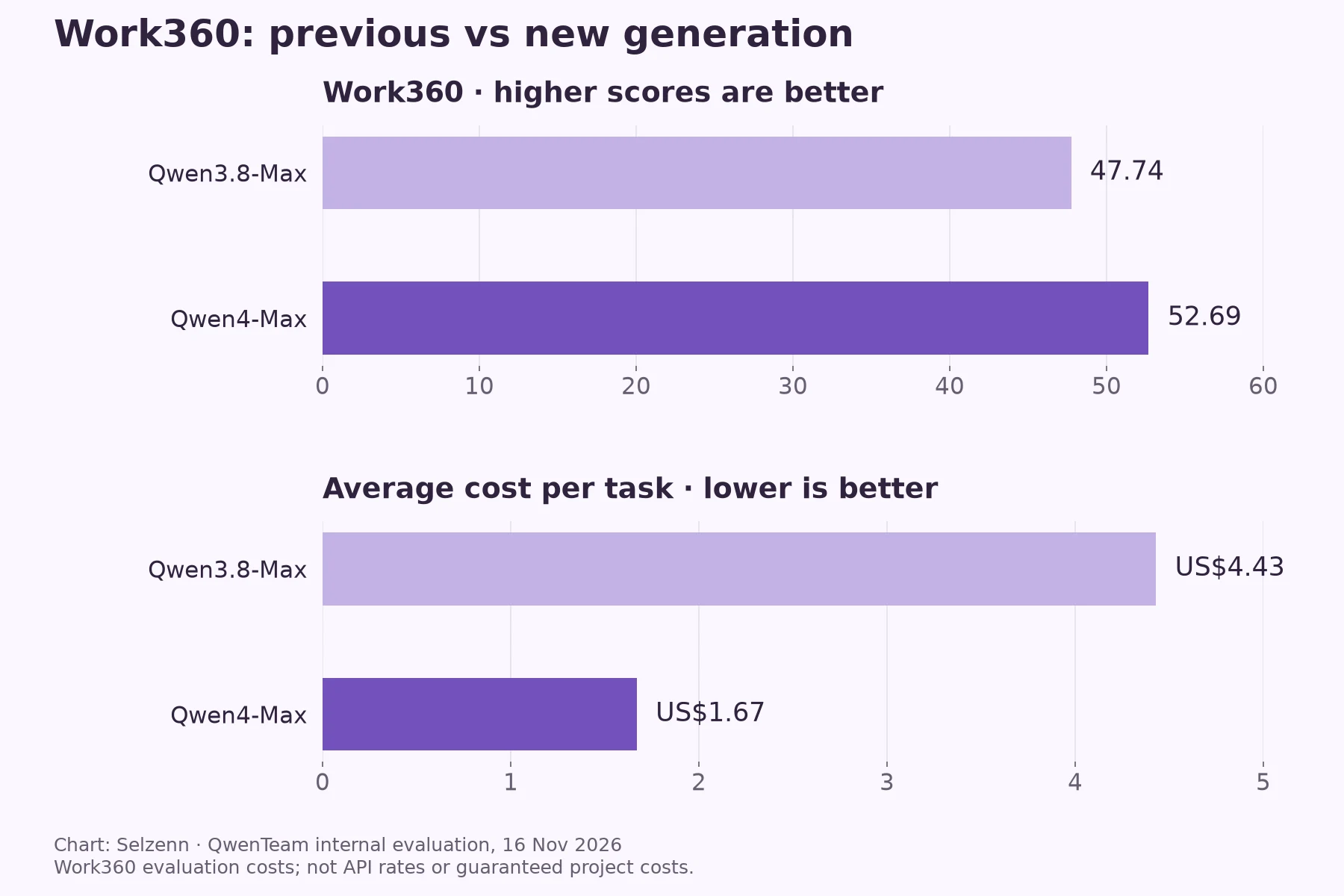
Those published cost values imply a reduction of about 62.3%. To estimate your application’s costs, use the relevant regional rates, token volume, caching and usage pattern. Tool use and repeated attempts also matter in an actual workflow.
More features: documents, manufacturing, cloud and research
| Area | Documented example |
|---|---|
| Professional documents | Sourced analysis, Excel workbooks and editable presentations |
| Manufacturing | 2D production layouts to 3D models, simulation and machining verification |
| Long-running agents | Staged plans and an early deliverable updated over time |
| Cloud | Resource scheduling optimized through feedback |
| Materials research | Coolant molecule design through an experimental platform |
| Drug research | Candidate molecules and computational evaluation for further validation |
| Code security | Functional and security checks during training, according to Alibaba |
Alibaba presents manufacturing, cloud scheduling and research examples as demonstrations or evaluations in particular environments. A candidate molecule is not an announcement of a clinically proven medicine. Tools, data and expert validation remain part of those workflows.
Model capabilities and the tools around them
QwenCloud’s documentation lists image/video understanding, function calling, structured output, MCP, web/PDF search, a code interpreter and caching. Understanding video differs from generating it; the WonderClip example involves an additional production workflow. Some capabilities also need compatible tool integrations and configuration.
For Live Delivery, the official plugin repository describes staged delivery so users can review and redirect the work. At launch it lists Codex CLI on Linux/macOS with Node.js 22+. That is this plugin’s scope, rather than a claim that every Qwen4-Max feature has the same platform limits.
Where can you try it?
Alibaba says Qwen4-Max is available through QwenCloud’s Token Plan and API, as well as products including QwenWork and QwenStudio. For developers, the documented model ID is qwen4-max. Check the relevant service region, endpoint, quota and pricing before connecting an application. Subscription-plan access and pay-as-you-go API usage have their own settings.
Can you download it and run it yourself?
Alibaba’s announcement says smaller open-weight models in the Qwen4 family will follow. That is separate from Qwen4-Max being available through cloud services. The announcement is not a download link for Qwen4-Max weights, and the smaller models’ release timing still needs confirmation.
The interesting next step is seeing how vision, long context and tool use come together in everyday work. Start with a small task and a result you can verify, then expand if it proves useful for what you actually need.
Sources & references
- Alibaba Cloud — Qwen4-Max launch announcement, November 16, 2026 ↗www.alibabacloud.com
- QwenTeam — Qwen4-Max: Your New Teammate Has Arrived, November 16, 2026 ↗qwen.ai
- QwenCloud Docs — Qwen4-Max specifications, API access and usage notes ↗docs.qwencloud.com
- QwenLM — Live Delivery plugin, platforms and requirements ↗github.com